Virtual Cell Challenge 2026 (10th of 806 teams)
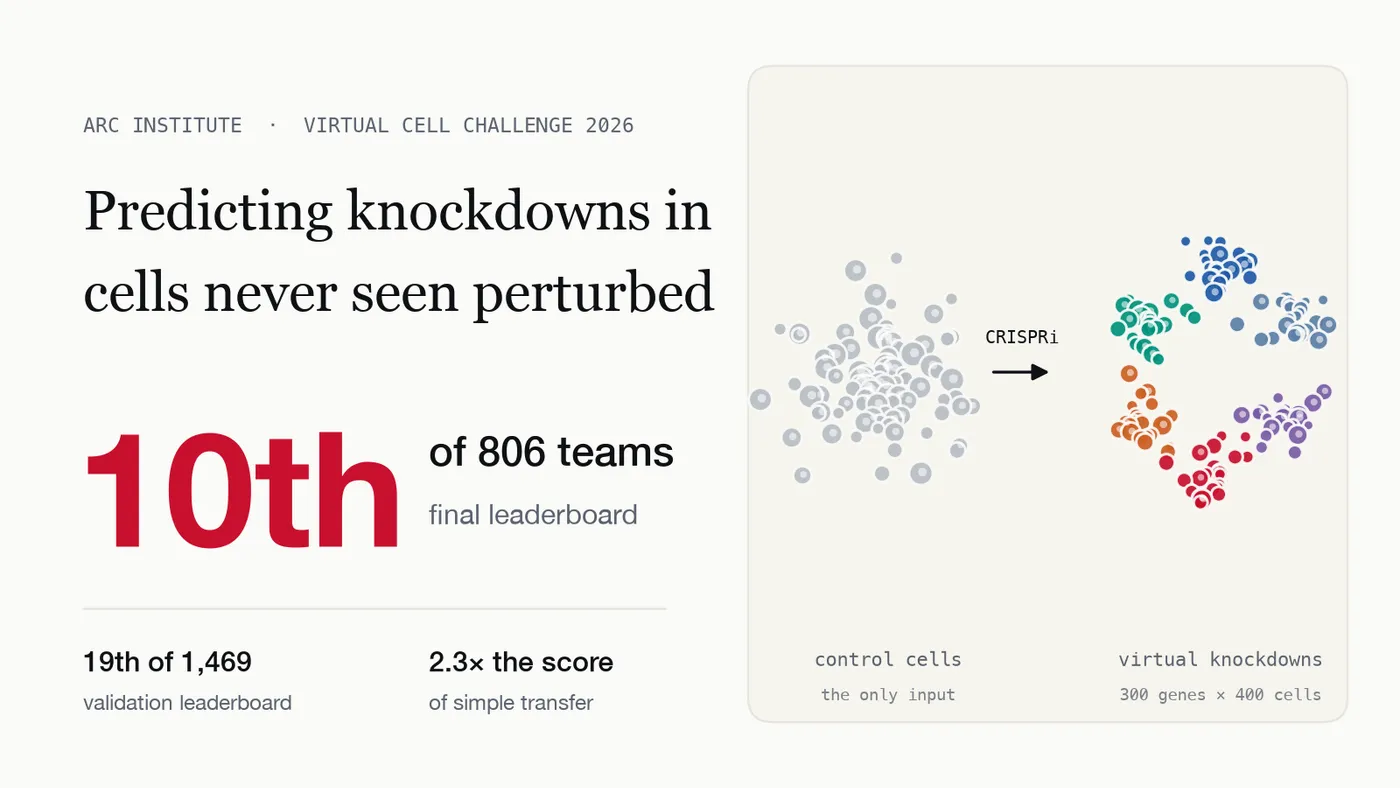
Zero-shot prediction of single-cell responses to CRISPRi knockdowns in cell lines with no perturbation data, for the Arc Institute Virtual Cell Challenge 2026. Our 25-step transfer pipeline finished 10th of 806 teams on the final leaderboard and more than doubled the score of simple transfer.
The challenge
The Virtual Cell Challenge, set by the Arc Institute, asks a question that matters for patient cells: can we predict how a cell responds to a perturbation when the experiment is hard to run? In 2026 the task was zero-shot. For each of six cell lines, teams received only untreated control cells and a list of 300 genes to be knocked down by CRISPRi. From that alone, they had to predict the single-cell gene expression profile after each knockdown.
Three cell lines formed the validation leaderboard. Three more were held back, with a different set of target genes, for the final test. Each entry was scored as the mean of six metrics covering the whole expression profile and the differential expression calls, normalised so that 0 matches a simple baseline and 1 matches a repeat experiment. In total, 1,469 teams submitted to the validation leaderboard and 806 made the final leaderboard.
Our approach
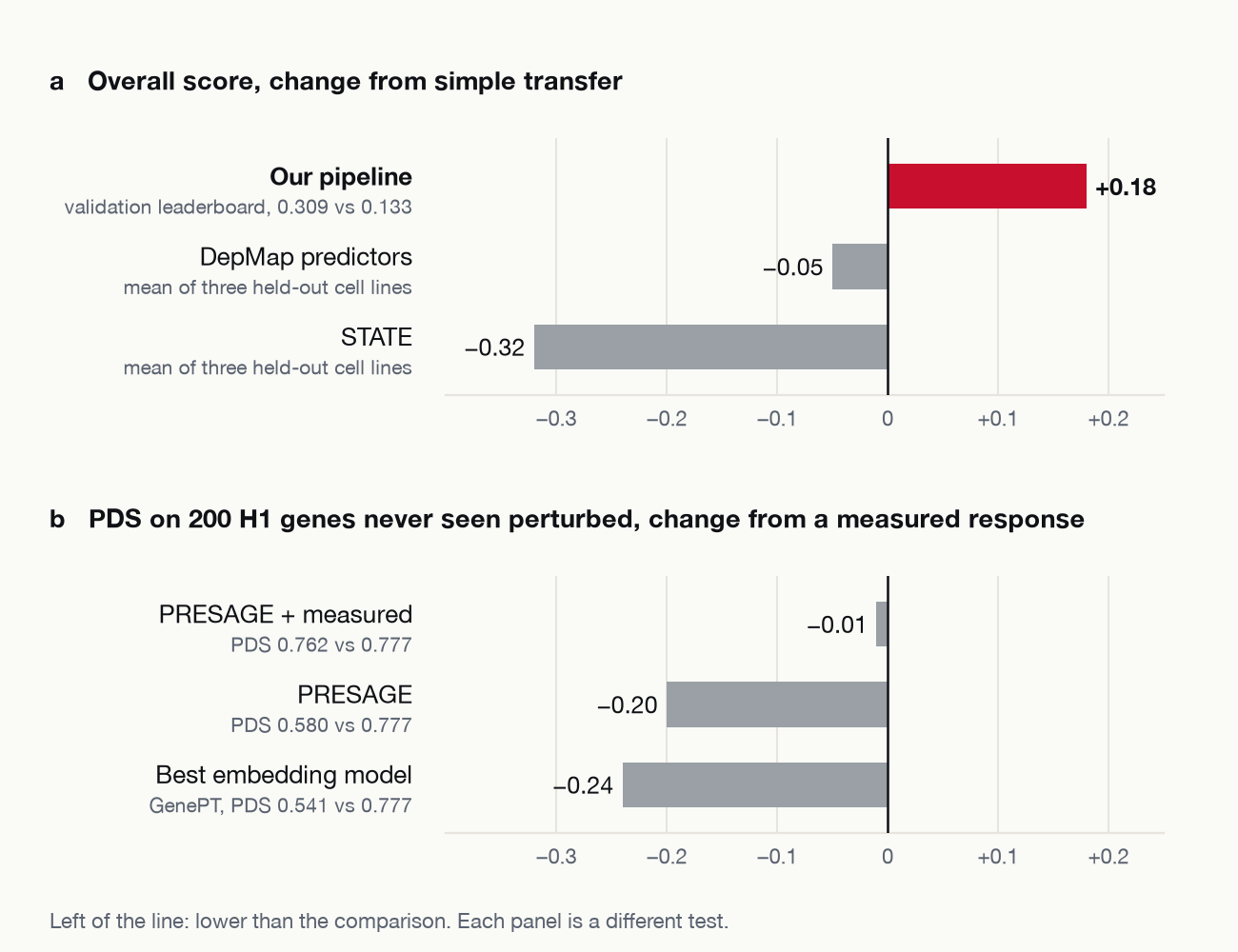
Before building anything, we tested the published models against the simplest possible baseline: find the same knockdown in public data from other cell lines and use its average effect. None of them beat it, so we built on transfer rather than replacing it. The final entry is a 25-step pipeline in four stages. Statistics carry the transfer, and machine learning models then refine the result.
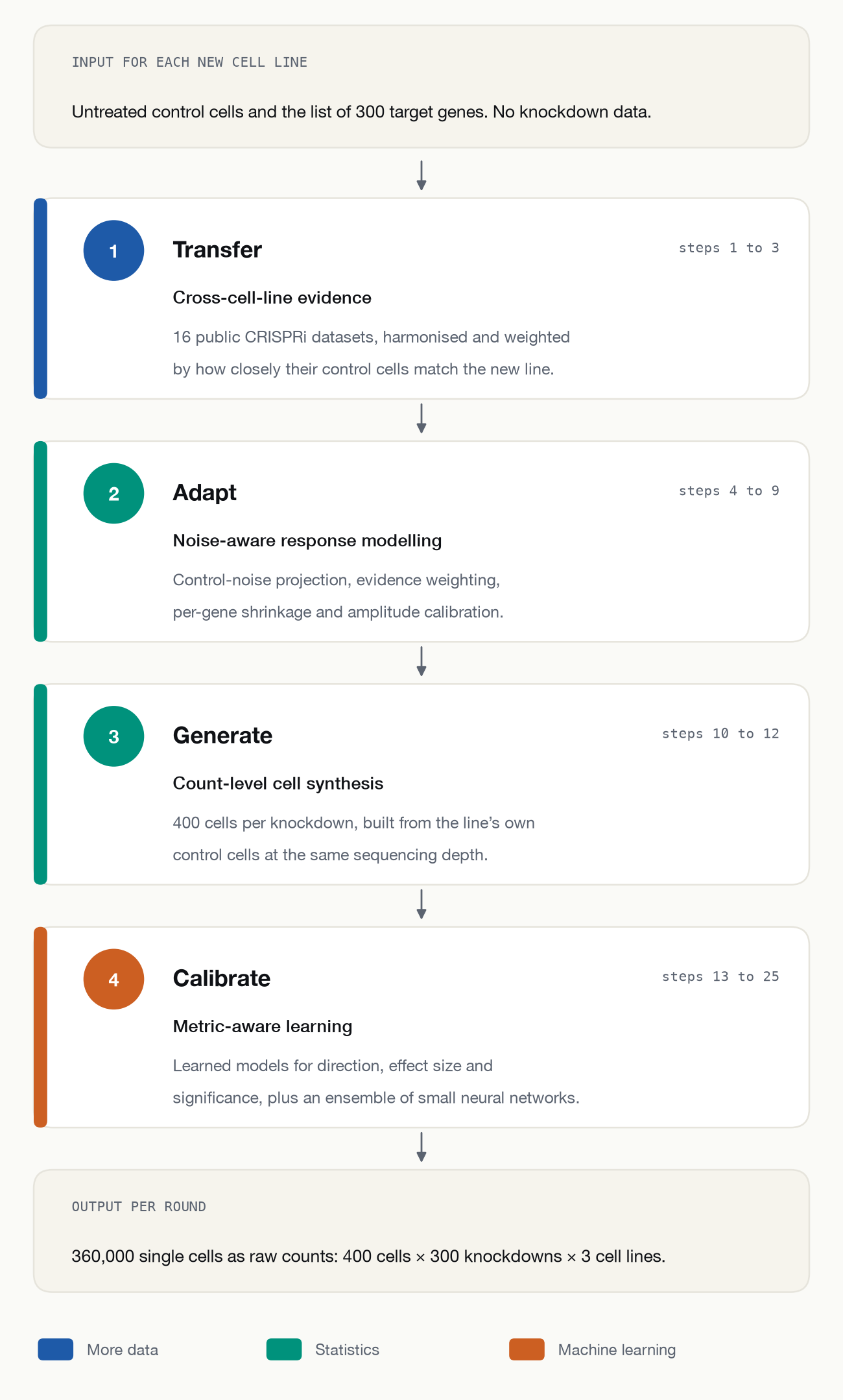
- Transfer. Evidence comes from 16 public CRISPRi screens, harmonised and weighted by how closely each screen’s control cells resemble the new cell line.
- Adapt. Noise-aware modelling removes control-noise directions, shrinks weakly supported gene effects and calibrates the amplitude of each response.
- Generate. Predicted responses are written into real count data: 400 cells per knockdown, built from the cell line’s own control cells at the same sequencing depth, for 360,000 cells per round.
- Calibrate. Learned models correct direction, effect size and significance, with a small ensemble of neural networks on top.
Result
We finished 10th of 806 teams on the final leaderboard, after placing 19th of 1,469 on validation. The final ranking uses cell lines and target genes that no team saw during validation, so it rewards models that generalise rather than models tuned to the public board.
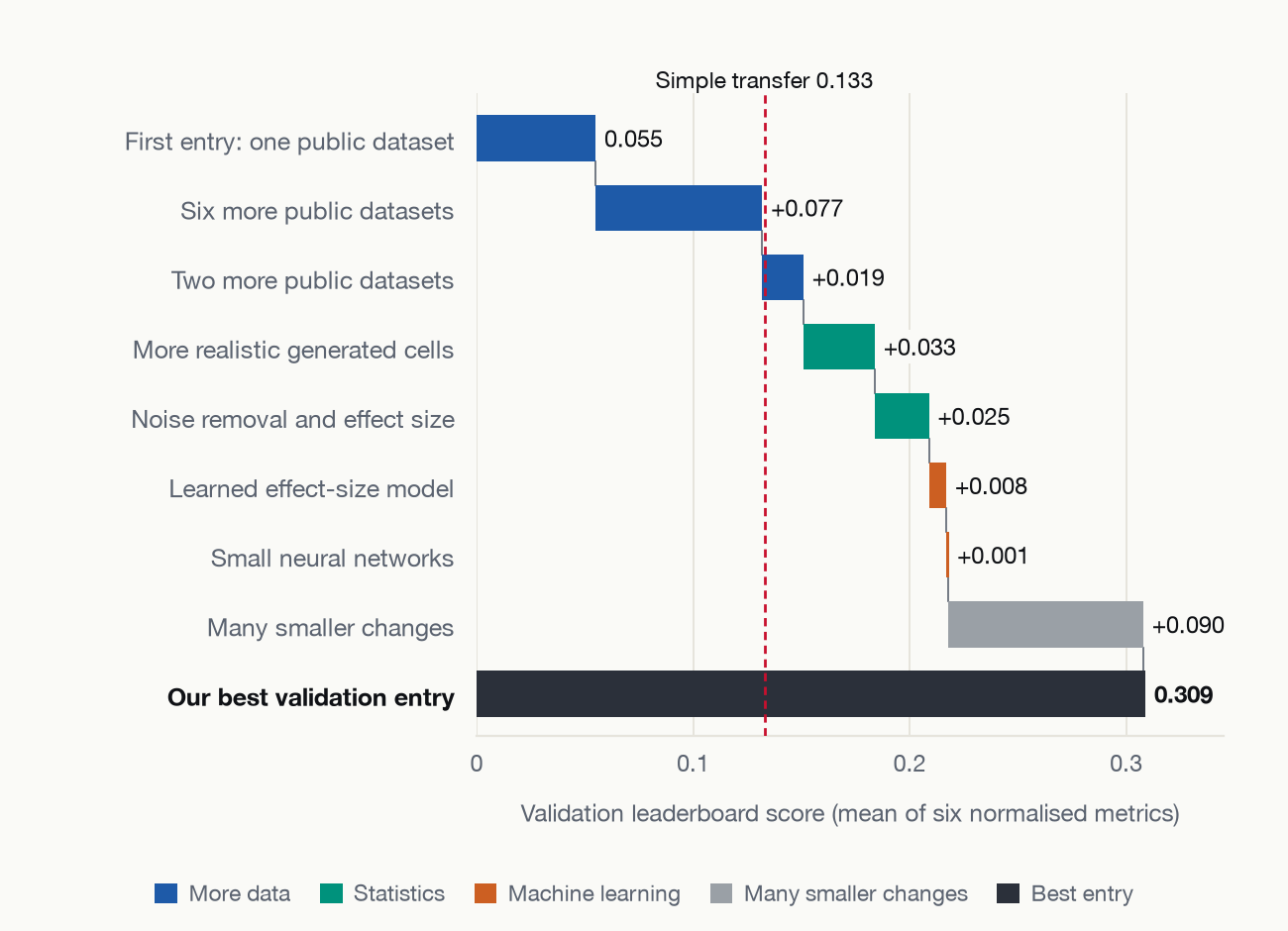
On the validation leaderboard our best entry scored 0.309, against 0.133 for simple transfer. Most of that gain came from more data and careful statistics.
No published model we tested scored higher than simple transfer. Deep learning and foundation models that try to predict a response from scratch did worse than copying a response measured in another cell line.
What we learned
- More data helped most. Adding public datasets gave the largest gains. Published models gave no meaningful gain over a response measured in another cell line.
- Careful statistics paid off. Removing noise and generating more realistic cells added 0.058 to the score between them.
- The signal is weak. When a screen is split in half, a knockdown’s effect profile correlates only about 0.05 between the two halves.
- Predictions are not yet cell-specific. Among the top ten entries, predictions for different cell lines were 0.77 to 0.89 similar to each other, while real responses are only 0.55 similar. This is the open problem.
What could be next: proteomics
All of the challenge data, and every model built for it, uses RNA. Across the 949 cancer cell lines in the ProCan proteomic map, the median protein-RNA correlation is only 0.42, and a CRISPRi knockdown acts on the cell through the protein it removes. We are exploring three follow-ups with data ProCan already holds:
- Describe each cell line by its proteome, and use that to choose which public responses to transfer.
- Predict how the proteome responds to a drug or knockdown, learning from perturbation proteomics datasets.
- Build proteomic models and a shared benchmark, starting from the proteomic foundation model we are developing at ProCan.